Long Tone: Thesis Studio with David Gersten / Camille Coleman
In Praise of Nomads
for Camille Coleman
There are artists whose contributions can be counted in objects, in hours, in the visible accumulation of effort. And then there are artists like Camille Coleman, whose presence resists such accounting, whose gift to a community is not consistency but movement, not predictability but the shimmering possibility of arrival.
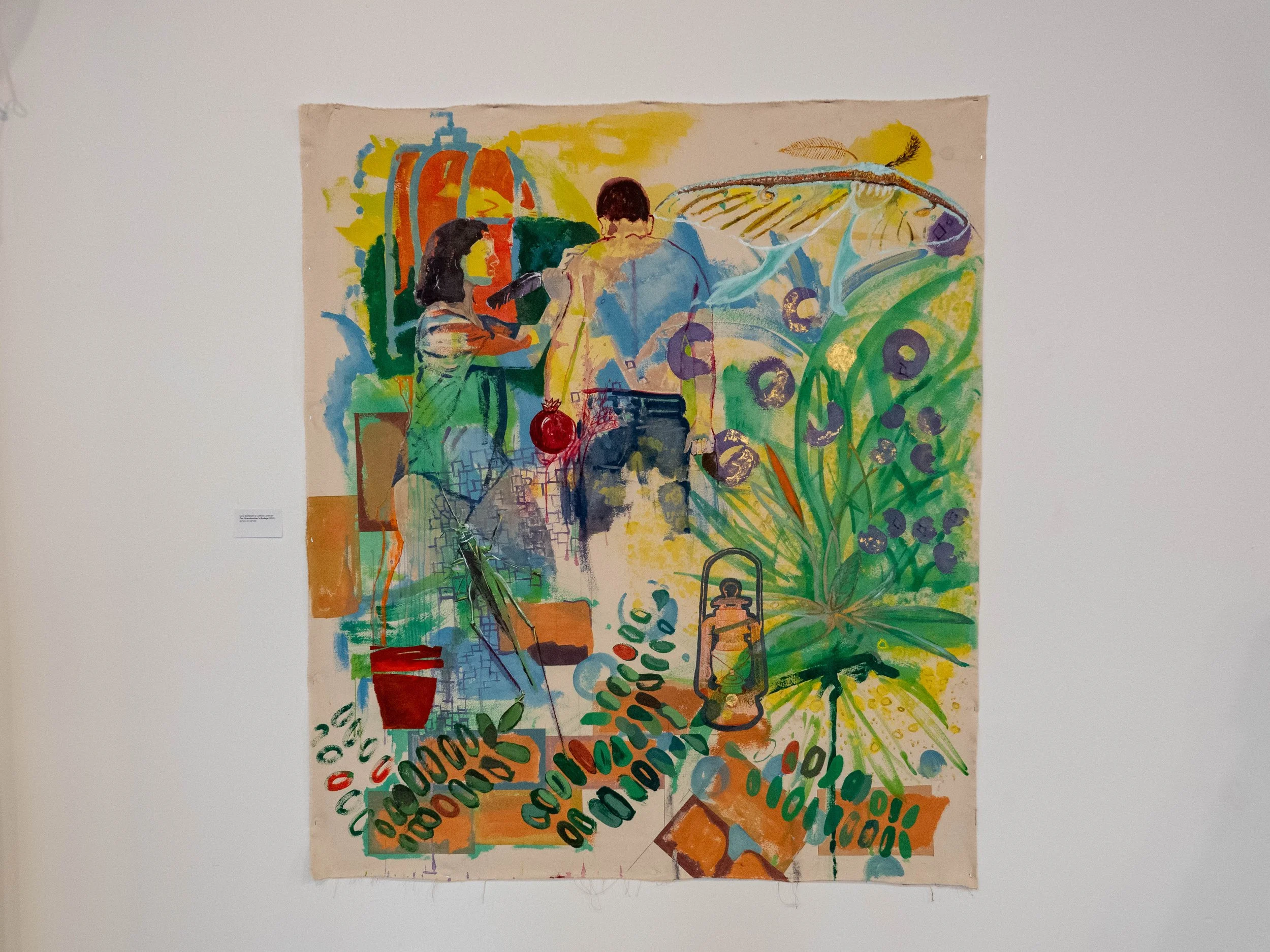
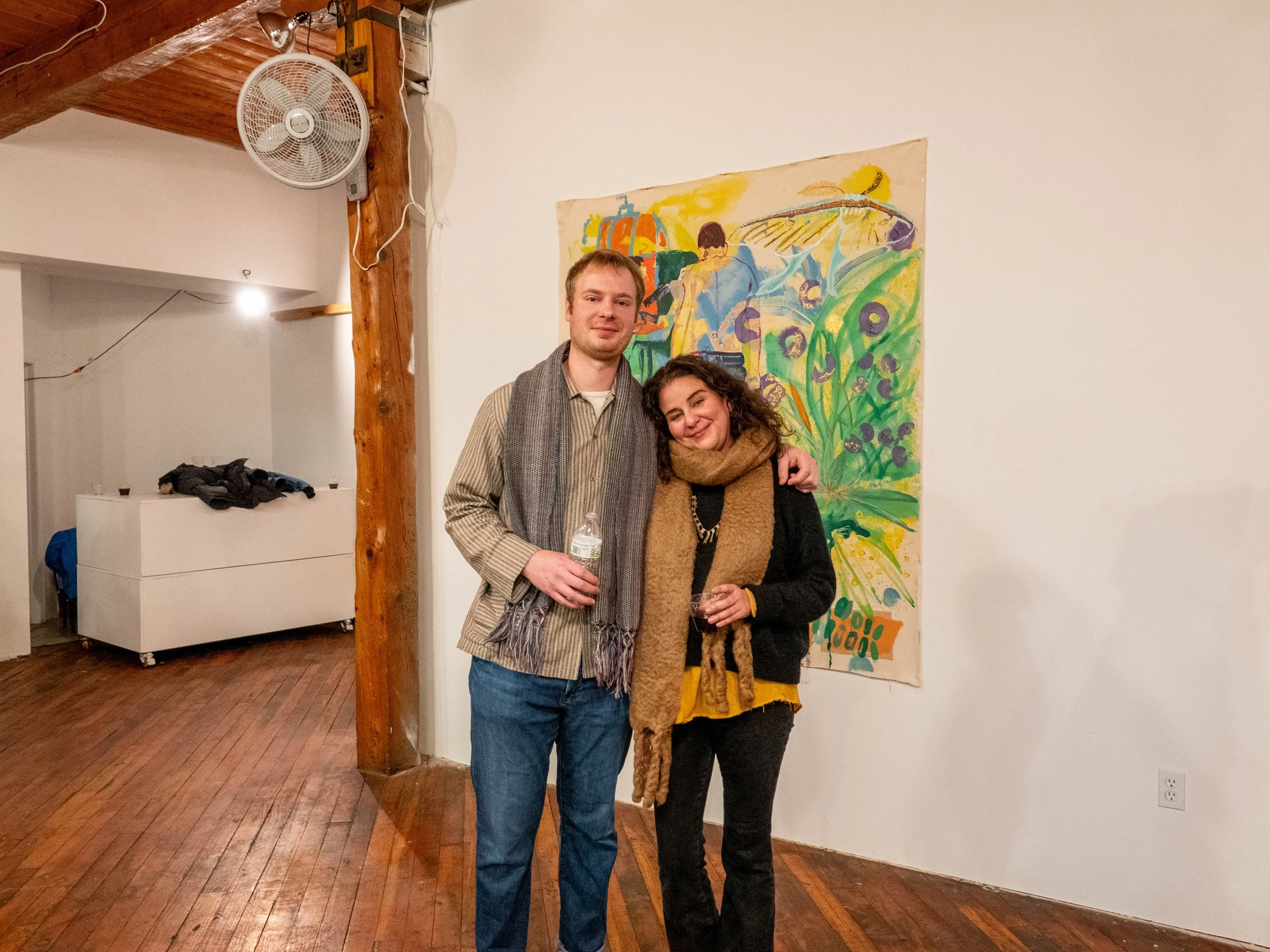
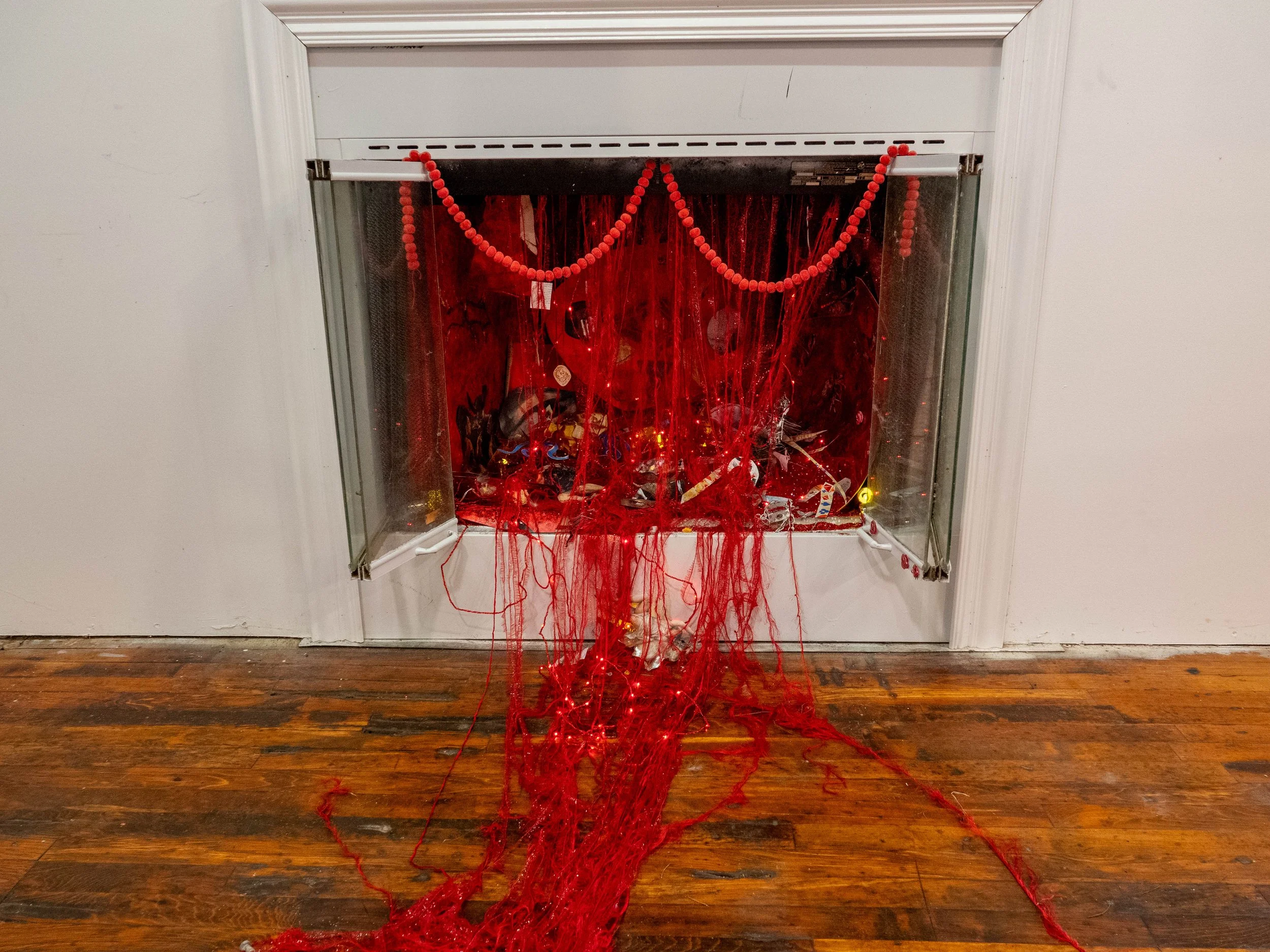
Camille lived the Long Tone program as a nomad, and in doing so revealed something essential about what an open, porous creative community can be. Her work appeared in bursts: collaborative paintings, feverish collages, and finally an altar assembled inside a fireplace, a gesture that felt both ancient and mischievous, like a shrine built in the wrong place on purpose. But more than any single work, it was her rhythm of appearing and disappearing that impacted the ecology of the group.
Some might see such intermittency as a lack, a refusal to commit. But that is only true in communities that mistake stability for virtue. In a truly open field of learning, the nomad is not a disruption but a necessary figure, a carrier of other tempos, other ways of belonging.
Deleuze and Guattari describe nomadism as a mode of thought that belongs to the multiple, to the environment in which it unfolds. Nomadic presence is not defined by absence but by movement across a plane, by the ability to cross thresholds others do not see. It resists codification, refuses to be captured by the laws and contracts that traditional structures rely on. The nomad is not outside the community; the nomad expands the community by refusing to let it harden.
Camille brought exactly this kind of expansion.
Her arrivals were never expected, yet once she was there, they felt inevitable. Her paintings with others were less collaborations than encounters, brief crossings of trajectories. Her collages felt like dispatches from a fever dream, torn and reassembled with the urgency of someone who knows the world is always already in motion.
And that altar, that glowing hearth inside a hearth, was perhaps the clearest expression of her nomadic logic. It was a site of temporary devotion, meaningful precisely because it was not meant to last. A fireplace is a place for burning, for transformation, for the passage of one state into another. To build an altar there is to declare that the sacred is not fixed; it flickers, migrates, appears where it is least expected.
In this sense, Camille’s presence was a kind of geophilosophy, a way of creating concepts that favor space and the crossings that occur within it. She reminded the group that a community is not a fortress but a field, and fields need winds, migrations, and unpredictable weather to stay alive.
Her unpredictability was not a flaw; it was a line of flight, she modeled a way of belonging that is not about staying but about returning, not about consistency but about intensity. She showed that presence can be episodic and that commitment can take the form of repeated departures, each one creating room for others to shift and reimagine their own trajectories.
There were also moments when Camille’s presence carried a different kind of intensity, the quiet tremors of inner struggle, the sudden swell of uncertainty, the emotional weather that many institutions prefer to keep out of sight. But a community that aspires to be porous must remain open to the full range of human feeling, even the ones that make us shift in our seats. Camille reminded us that vulnerability is not a disruption but a form of knowledge, a way of speaking that often arrives before language. Her emotional honesty created small fractures in the usual armor we wear, and through those fractures, light entered.
To praise Camille is to praise the nomad, the one who refuses to be captured, who brings with her the outside, the open, the figure of outwardness. She carried the spirit of becoming that Deleuze describes: identity not as a fixed point but as movement across the plane of immanence.
In the end, Camille’s contribution to Long Tone was not (only) the works she made but the space she opened, the reminder that a community is healthiest when it can hold many forms of presence, many rhythms, many ways of arriving, being, and becoming.
She reminded us that the nomad is not the one who lacks a home, but the one who makes every place more spacious simply by passing through.
Thank you, Camille.
David Gersten | December 2025
Founding Director
Arts Letters and Numbers